
TI CC1350 LaunchPad XL
Texas Instruments SimpleLink(TM) CC1350 Wireless MCU LaunchPad(TM) Kit
Overview
Section titled “Overview”The LAUNCHXL-CC1350 is a Texas Instrument’s development kit for the CC1350 SoC MCU which combines a Cortex-M3 microcontroller alonside a dedicated Cortex-M0 to control a dual-band radio.
Hardware
Section titled “Hardware”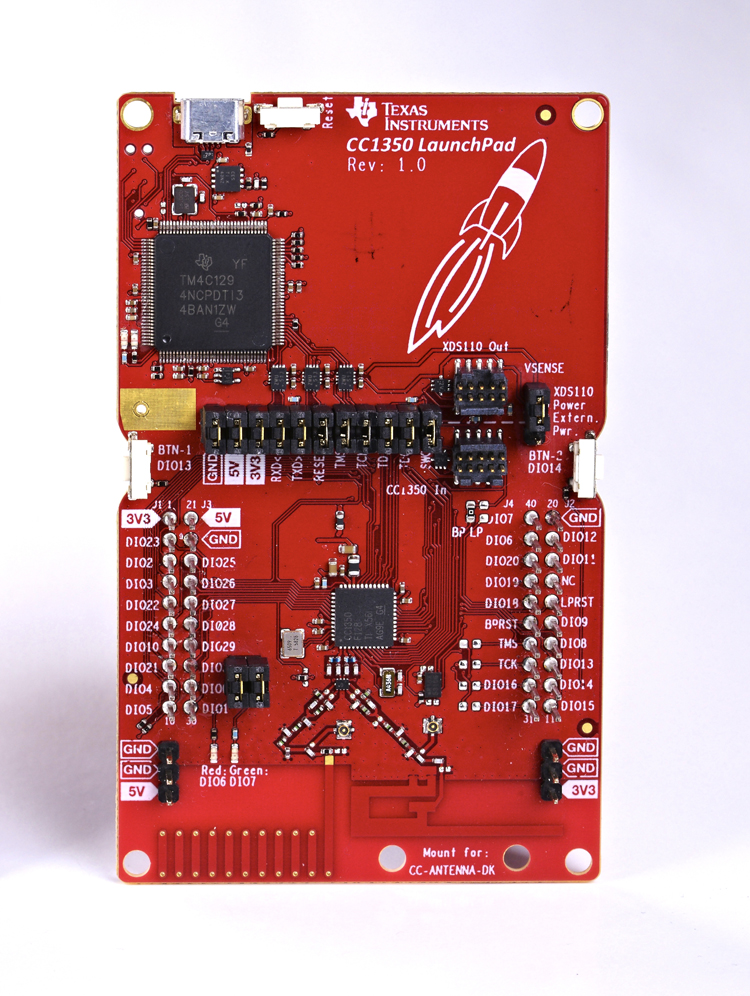
| MCU | CC1350 |
|---|---|
| Family | ARM Cortex-M3 |
| Vendor | Texas Instruments |
| RAM | 20KiB |
| Flash | 128KiB |
| Frequency | 48MHz |
| FPU | no |
| Timers | 4 |
| ADCs | 1x 12-bit (channels) |
| UARTs | 1 |
| SPIs | 2 |
| I2Cs | 1 |
| Vcc | 1.8V - 3.8V |
| Datasheet | Datasheet |
| Reference Manual | Reference Manual |
Board pinout
Section titled “Board pinout”The CC1350 Quick Start Guide provides the default pinout for the board.
Flashing the Device
Section titled “Flashing the Device”Flashing RIOT is quite straight forward. The board comes with an XDS110 on-board debug probe that provides programming, flashing and debugging capabilities through the USB Micro-USB connector. Once either TI Uniflash or OpenOCD are installed just connect the board using the Micro-USB port to your computer and type:
BOARD=cc1350-launchpad make flashTo use OpenOCD instead of uniflash we need to set the PROGRAMMER environment
variable, this is to enable OpenOCD instead of Uniflash.
PROGRAMMER=openocd BOARD=cc1350-launchpad make flashAccessing RIOT shell
Section titled “Accessing RIOT shell”Default RIOT shell access utilize XDS110 debug probe integrated with launchpad board. It provides virtual serials via USB interface - for connecting to RIOT shell, use the first one (with TI drivers for Windows named “Class Application/User UART”).
If a physical connection to UART is needed, disconnect jumpers RXD and TXD joining cc1350 microcontroller with XDS110 and connect UART to pin RXD/DIO2
The default baud rate is 115 200 - in both connection types.
More information
Section titled “More information”For detailed information about CC1350 MCUs as well as configuring, compiling RIOT and installation of flashing tools for CC1350 boards, see CC26xx/CC13xx common.