
SODAQ Autonomo
Support for the SODAQ Autonomo board.
Support for the SODAQ Autonomo board.
Overview
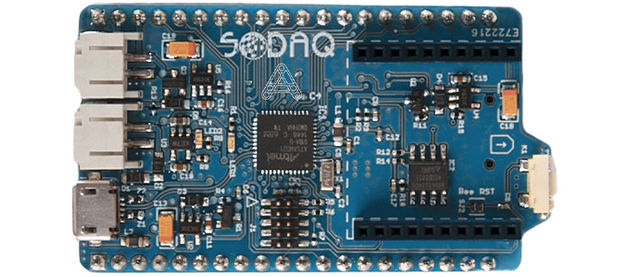
The SODAQ Autonomo is a board by SODAQ featuring a ATSAMD21J18A. The SAMD21
is a ARM Cortex-M0+ micro-controller. It has 256Kb of flash memory and 32Kb of
RAM.
The Autonomo is available from the SODAQ shop.
Hardware
MCU
| MCU | ATSAMD21J18A |
|---|---|
| Family | ARM Cortex-M0+ |
| Vendor | Atmel |
| RAM | 32Kb |
| Flash | 256Kb |
| Frequency | up to 48MHz |
| FPU | no |
| Timers | 6 (1x 16-bit, 2x 24-bit, 3x 32-bit) |
| ADCs | 1x 12-bit (8 channels) |
| UARTs | max 6 (SERCOMs shared with SPI and I2C) |
| SPIs | max 6 (see UART) |
| I2Cs | max 6 (see UART) |
| Vcc | 1.8V - 3.6V |
| Datasheet | Datasheet |
User Interface
1 LED:
| Device | PIN |
|---|---|
| LED0 | PA19 |
Implementation Status
Please refer to this tracker to see which projects are work in progress and who is the contact person for this. Notice that the initial support for the Autonomo was based on samr21-xpro. At some point we will add a separate issue to track changes for this board.
| Device | ID | Supported | Comments |
|---|---|---|---|
| MCU | samd21 | partly | Energy saving modes not fully utilized |
| Low-level driver | GPIO | yes | |
| PWM | yes | ||
| UART | yes | two UARTs by now | |
| I2C | yes | ||
| SPI | yes | ||
| ADC | yes | PA04 & PA05 disabled by default due to EDBG’s use of them for UART, can be enabled from periph_conf.h |
|
| USB | no | ||
| RTT | yes | ||
| RTC | yes | ||
| RNG | no | no HW module | |
| Timer | yes |
Features of the board
Besides the SAMD21 the board has the following features:
| Feature | Description |
|---|---|
| Compatibility | Arduino M0 compatible |
| Size | 58.5 x 33.5 mm |
| Operating Voltage | 3.3V |
| Digital I/O Pins | 16, with 12 PWM, UART, SPI and TWI (I2C) |
| Analog Input Pins | 6, 12-bit ADC channels |
| Analog Output Pins | 10-bit DAC |
| External Interrupts | Available on all pins except pin 4 |
| DC Current per I/O pin | 7 mA |
| EEPROM | Up to 16KB by emulation |
| Clock Speed | 48 MHz |
| Debug | Serial Wire Interface |
| Communications | Bee compatible slot for communication modules with software switchable power |
| Storage | 16Mbit Dataflash Module and Micro SD card holder |
| Power | 5V USB power and/or 3.7V LiPo battery |
| Power switch | Software switchable power for connected devices up to 1A |
| Charging | Solar charge controller, up to 500mA charge current |
| LED’s | Yellow charge LED and green LED on pin 13 |
Flashing the device
Use BOARD=sodaq-autonomo with the make command.
Example with hello-world application:
make BOARD=sodaq-autonomo -C examples/basic/hello-world flashNote: If the application crashes, automatic reflashing via USB won’t be possible. In this case, the board must be set in bootloader mode by double tapping the reset button before running the flash command.
Accessing STDIO via UART
STDIO of RIOT is directly available over the USB port.
The TERM_DELAY environment variable can be used to add a delay (in second)
before opening the serial terminal. The default value is 2s which should be
enough in most of the situation.